Knee Cartilage Damage: Can It Heal Without Joint Replacement Surgery?
Introduction
Does knee pain always mean you need a joint replacement? Not at all. Knee cartilage damage can range from mild wear and small injuries to advanced cartilage loss, and the right treatment depends on the cause, how severe the damage is, your age, your activity level and the overall health of your knee. Cartilage does not heal well on its own, but many people reduce pain and move better with non-surgical or joint-preserving treatment, especially when the problem is caught early. What Is Knee Cartilage?
This covers the symptoms, causes and treatment options, and how doctors decide when replacement is really needed.
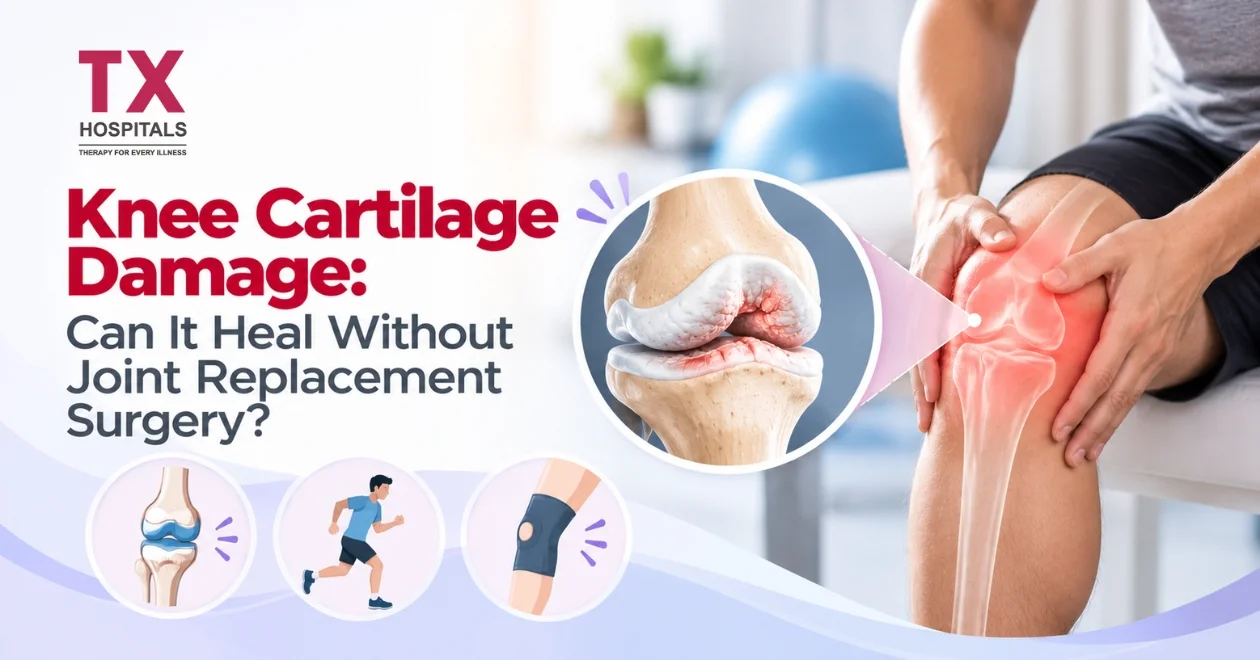
Cartilage is the smooth, rubbery tissue that covers the ends of the thigh bone and shin bone, and the back of the kneecap. It lets the joint glide and absorbs shock when you walk, climb stairs or run.
When cartilage thins or tears, the bones and surrounding tissues take more load. The knee becomes painful, stiff and slower to move.
Common symptoms of knee cartilage damage:
• Pain that increases with activity or stairs
• Swelling after walking or standing for long
• Stiffness after sitting or first thing in the morning
• Clicking, grinding or a catching feeling
• Difficulty fully bending or straightening the knee
What Causes Knee Cartilage Damage?
Damage can build up slowly or happen in a moment.
• Osteoarthritis: the most common cause. Cartilage gradually thins with years of use.
• Sports and accidents: a twist, fall or direct blow, common in football, cricket, basketball and running.
• Previous knee injuries: an old meniscus or ligament tear changes how the knee carries weight and can wear cartilage faster.
• Repeated stress and extra weight: every extra kilo adds several kilos of load on the knee with each step.
• Age: cartilage becomes less resilient over time.
Can Damaged Knee Cartilage Heal on Its Own?
Only to a limited extent. Cartilage has almost no blood supply, so it cannot repair itself the way skin or muscle does. Small, shallow damage may settle with rest and rehabilitation. Deeper damage rarely heals fully without help.
That does not mean replacement is the only answer. Treatment can ease symptoms, protect the cartilage you still have and slow further wear.
How Doctors Grade Cartilage Damage
An examination, X-ray and often an MRI show how far the damage has gone. Doctors commonly grade it from 1 to 4
• Grade 1: the surface is softened but intact.
• Grade 2: the surface is frayed, with less than half the thickness affected.
• Grade 3: deep cracks reaching more than half the thickness.
• Grade 4: cartilage is worn through and bone is exposed.
Grades 1 to 3 usually respond to non-surgical care or joint-preserving procedures. Replacement is mainly discussed at grade 4 or when other treatment has failed.
Treatment Options Without Knee Replacement
Physiotherapy and exercise
Stronger thigh and hip muscles take load off the joint. A physiotherapist builds a plan around your knee, usually with low-impact activity such as cycling, swimming and walking on level ground.
Weight management
Losing even a few kilos can noticeably reduce knee pain, and it protects the joint over the long term.
Medicines and injections
Pain relievers and anti-inflammatory medicines help in flare-ups. Injections such as hyaluronic acid or PRP (platelet-rich plasma) are sometimes used, and steroid injections can give short-term relief. Results vary from person to person, and injections work best alongside physiotherapy, not instead of it.
Cartilage repair procedures.
For a localized defect, often in a younger or active patient, options include:
• Microfracture: tiny holes in the bone encourage a repair tissue to form.
• Mosaicplasty (OATS): healthy cartilage plugs are moved to the damaged spot.
• Cell-based repair (ACI/MACI): cartilage cells are grown and implanted into the defect.
These suit specific defects, not widespread arthritis.
Realignment and related repairs
If bowed legs or a torn meniscus or ligament is overloading one side of the knee, correcting that problem can relieve the damaged area. High tibial osteotomy, which reshapes the shin bone to shift weight, is one example.
When Is Knee Replacement Considered?
Your doctor may discuss replacement if:
• Pain continues despite proper non-surgical treatment
• Imaging shows severe cartilage loss or advanced arthritis
• Walking, stairs or daily tasks have become difficult
• Pain disturbs your sleep
• The knee is very stiff or deformed
The decision rests on your symptoms, examination, scans, activity level and general health. An X-ray alone does not decide it. In some patients only one part of the knee is damaged, and a partial replacement may be an option.
When to See an Orthopedic Doctor
Get your knee checked if pain lasts more than two to three weeks, or if swelling, stiffness or a giving-way feeling keeps returning.
See a doctor urgently if you have:
• A knee that locks and will not straighten
• Sudden, severe swelling after an injury
• Inability to put weight on the leg
• A hot, red, swollen knee with fever
Early assessment gives you more options. The Orthopedic specialists team at TX Hospitals evaluates knee pain, cartilage damage and arthritis and builds a treatment plan around your age, activity and scan findings.
To book a consultation, call +91 91445 14459
*This article is for general information and does not replace medical advice.
Frequently Asked Questions
Disclaimer
The information provided in this blog is for general health awareness and educational purposes only. It should not be considered a substitute for professional medical advice, diagnosis or treatment. The content may not apply to every individual's health condition. Always consult a qualified healthcare professional for any medical concerns or treatment decisions. Do not ignore or delay medical advice based on the information shared in this blog.
Share this






Book Appointment
Categories
- Health Care
- Mother & Child
- Pediatric
- Health Days
- Urology
- Dental
- Gastroenterology
- Neurology
- Gynecology
- Orthopedics
- Cardiology
- Oncology
- Robotic Sciences
- Nephrology
- Rheumatology
- Pulmonology
- Cardiothoracic & Vascular Surgery
- Internal Medicine
- General Medicine
- Gastroeneterology
- Endocrinology
- Dermatology
- Pediatric Urologist
- Ophthalmology
- Gynecologist
- Ophthalmologist
- Ent
- Psychiatry
- Pediatrician
- Health Day
- Orthopaedics
- Spine Surgery
- General Physician
- Awarness Day
- Liver Transplantation Surgery
- Robotic Gastrointestinal (GI) Surgery
- Cardiac Sciences
- internal medicine
- General Surgeries
- Health care
- ENT
- cardiothoracic & vascular surgery
- Pediatric Neurologist
- Gastroenterologist
- Gynecology Hospitals
- oncology
- Trauma Surgeons
- Neuro Sciences
- Internal Madicine
- cardiac sciences
- Genecology
- Dietician
- Diabetology